


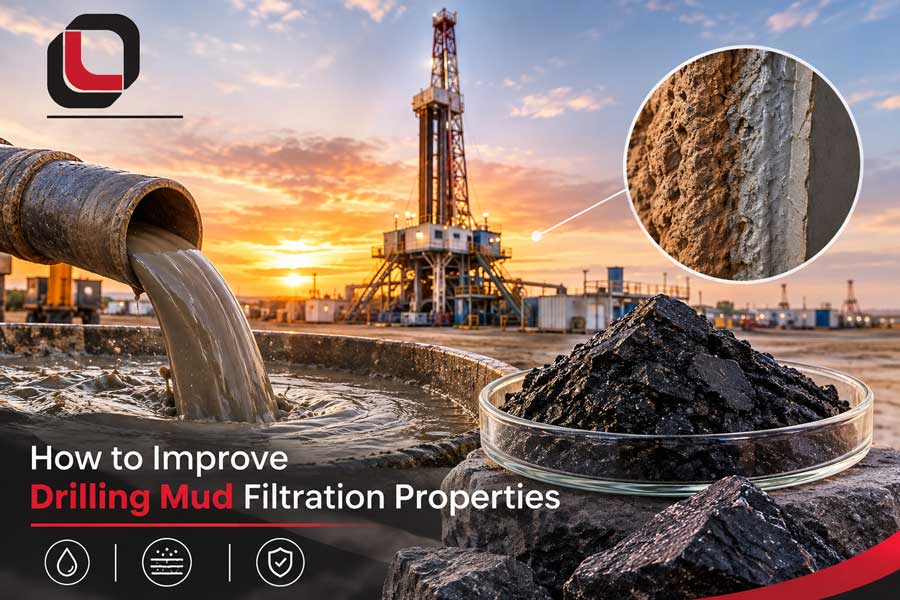
Drilling mud plays a critical role in maintaining wellbore stability, transporting drilled cuttings, cooling drilling equipment, and controlling formation pressure during oil and gas drilling operations. One of its most important characteristics is filtration performance. Poor filtration control can lead to excessive fluid invasion, formation damage, unstable wellbores, thick filter cakes, and costly drilling complications.
Improving drilling mud filtration properties requires a combination of proper fluid formulation, effective filtration-control additives, particle-size optimization, and continuous monitoring. Selecting the right additives is particularly important when drilling through permeable formations or operating under high-pressure and high-temperature (HPHT) conditions.
This guide explores practical methods for improving drilling mud filtration properties and explains how materials such as bentonite, polymers, and Gilsonite can contribute to better fluid-loss control.
1. Understanding Drilling Mud Filtration Properties
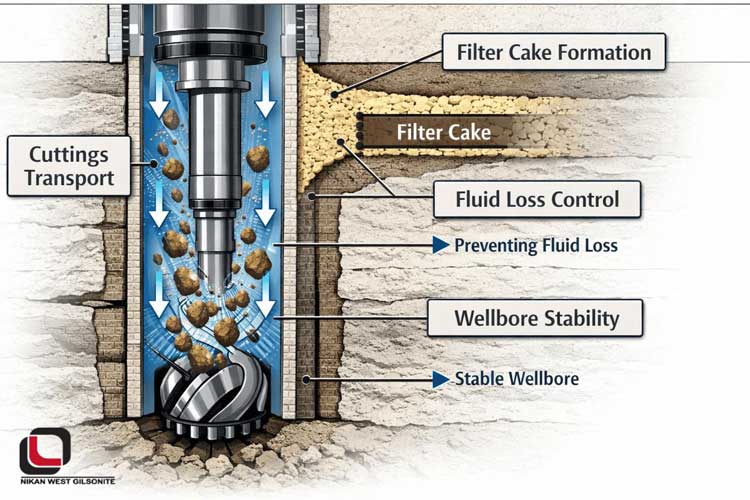
Filtration occurs when the liquid phase of drilling mud, known as filtrate, moves from the wellbore into permeable formations under differential pressure. As this process continues, solid particles accumulate on the formation surface and create a layer called filter cake.
A properly developed filter cake should be thin, compact, uniform, and relatively impermeable. These characteristics help minimize fluid invasion and protect the formation.
Two important filtration measurements are:
- API Fluid Loss: Measures the volume of filtrate passing through a filter medium under standardized low-temperature and low-pressure testing conditions.
- HTHP Fluid Loss: Evaluates filtration performance under high-temperature and high-pressure conditions, providing valuable information for demanding drilling environments.
High fluid-loss values may indicate inadequate filtration control, while an excessively thick or poorly structured filter cake can increase differential sticking risks and interfere with drilling operations.
Therefore, the objective is not simply to reduce filtrate volume. Operators must also maintain suitable mud rheology and develop a stable, low-permeability filter cake.

2. Optimize Bentonite Concentration and Mud Composition
Bentonite is one of the most widely used materials in water-based drilling mud systems. Its swelling and dispersion properties help increase viscosity, suspend drilled cuttings, and contribute to filter cake development.
However, the concentration and quality of bentonite must be carefully controlled.
Insufficient bentonite may result in weak particle packing and poor filtration performance. On the other hand, excessive bentonite can increase viscosity, reduce pumping efficiency, and create undesirable rheological conditions.
To optimize bentonite performance:
- Use drilling-grade bentonite with consistent quality.
- Ensure adequate hydration before introducing other additives when required by the mud formulation.
- Monitor plastic viscosity and yield point.
- Evaluate filtration performance after adjusting bentonite concentration.
- Consider water salinity and chemical contamination.
The interaction between bentonite particles and other mud components also affects filter cake structure. Research has shown that polymer content and particle interactions can significantly
influence filter cake compactness and filtration behavior.
3. Use Effective Polymer-Based Fluid Loss Control Additives
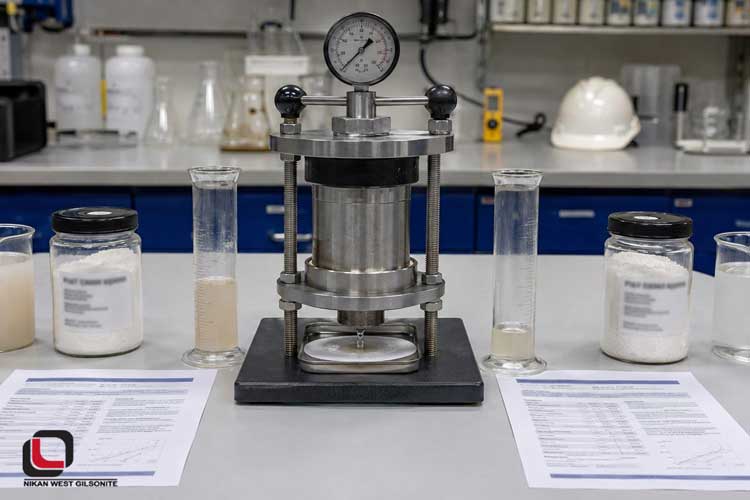
Polymers are widely used to improve drilling mud filtration properties, particularly in water-based systems. They help control filtrate movement by modifying particle interactions, improving dispersion, and reducing filter cake permeability. Selecting the right Fluid Loss Control Additive is essential for maintaining effective filtration control and minimizing fluid invasion into permeable formations.
Common polymer-based filtration-control additives include:
PAC (Polyanionic Cellulose): PAC is commonly used to reduce fluid loss and improve filtration control in water-based drilling fluids. It can also contribute to viscosity development.
CMC (Carboxymethyl Cellulose): CMC helps reduce water loss by improving the structure of the liquid phase and supporting filter cake formation.
PHPA (Partially Hydrolyzed Polyacrylamide): PHPA is primarily used for shale inhibition and encapsulation, although its contribution to filtration performance depends on the complete mud formulation.
Modified Starches: These additives can provide effective fluid-loss control, particularly in water-based mud systems.
When selecting a polymer, drilling engineers should consider temperature resistance, salinity tolerance, compatibility with other additives, and the required rheological properties.
Using the wrong polymer or excessive concentrations may increase viscosity and negatively affect fluid circulation. Laboratory testing is therefore essential before field application.
4. Improve Particle Size Distribution and Filter Cake Structure
Particle-size distribution is another important factor influencing drilling mud filtration performance.
A well-designed drilling fluid contains particles of different sizes that work together to fill formation pores and create an effective sealing layer. Larger particles can bridge pore openings, while smaller particles fill the spaces between larger particles.
This process helps develop a compact filter cake with reduced permeability.
Several approaches can improve particle-size distribution:
- Select suitable bridging materials based on formation pore size.
- Maintain an appropriate balance between fine and coarse particles.
- Avoid excessive accumulation of drilled solids.
- Use compatible sealing additives when drilling through highly permeable formations.
- Monitor filter cake thickness and quality during filtration testing.
The objective is to create a continuous sealing structure that minimizes fluid invasion without unnecessarily increasing mud viscosity or solids loading.
5. Control Mud Chemistry and Prevent Contamination
Chemical contamination can significantly affect drilling mud filtration properties. Salts, calcium, cement contamination, and other unwanted materials may interfere with clay hydration, polymer performance, and particle dispersion.
For example, excessive calcium contamination can cause bentonite particles to flocculate, potentially increasing filtration loss and changing mud rheology.
To maintain suitable chemical conditions, drilling engineers should:
- Regularly measure pH and relevant ionic concentrations.
- Monitor mud properties for signs of salt or calcium contamination.
- Use appropriate chemical treatments when necessary.
- Evaluate additive compatibility before introducing new materials.
- Recheck filtration performance after every significant chemical adjustment.
Maintaining chemical stability is especially important in water-based drilling fluids exposed to high salinity and elevated temperatures.
6. Use Gilsonite to Improve Drilling Mud Filtration Properties
Gilsonite is a naturally occurring solid hydrocarbon material, also known as natural bitumen or natural asphalt. It has important applications in oil and gas drilling, particularly in filtration control, shale stabilization, and wellbore strengthening.
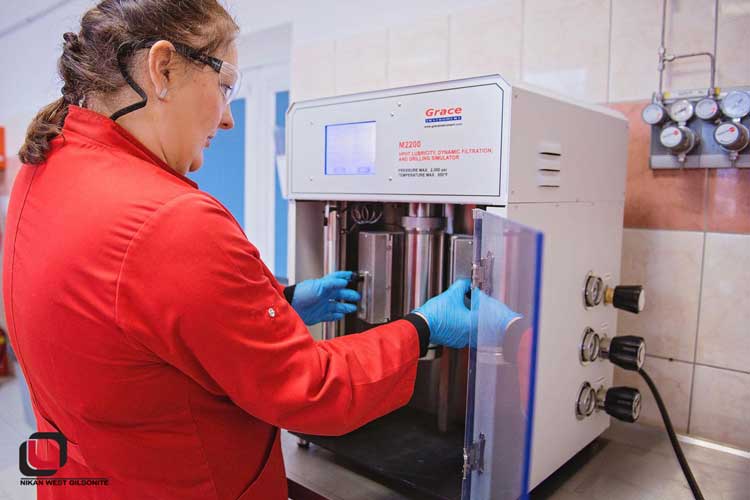
When properly selected and incorporated into a compatible drilling fluid, Gilsonite can help reduce filtrate invasion by sealing formation pores and microfractures and contributing to the development of a strong, low-permeability filter cake.
How Does Gilsonite Reduce Fluid Loss?
Gilsonite works through several mechanisms:
1. Sealing Formation Pores and Microfractures
Finely processed Gilsonite particles can enter or bridge suitable pore openings and microfractures. Under downhole conditions, their thermoplastic behavior can help improve sealing and reduce fluid penetration into permeable formations.
2. Improving Filter Cake Quality
Gilsonite contributes to the formation of a more effective sealing layer on the wellbore wall. A properly designed filter cake helps minimize filtrate invasion and supports wellbore stability.
3. Supporting Shale Stabilization
Fluid invasion can contribute to shale hydration, swelling, and instability. By reducing filtrate penetration, suitable Gilsonite grades can help protect sensitive formations and reduce associated drilling problems.
4. Supporting HPHT Filtration Control
Certain Gilsonite grades are designed for demanding drilling environments. Their softening-point characteristics and particle-size distribution can make them useful in high-temperature applications, depending on the mud system and downhole conditions.
Selecting the Right Gilsonite Powder
The performance of Gilsonite depends on several technical characteristics, including:
- Particle-size distribution
- Softening point
- Ash content
- Moisture content
- Compatibility with the drilling fluid
- Downhole temperature and pressure
For this reason, selecting suitable Gilsonite Powder is an important step in developing an effective filtration-control program.
Gilsonite is available in different grades and particle sizes. The appropriate product should be selected according to the drilling fluid type, formation characteristics, and required filtration performance.
It is also important to distinguish between standard natural asphalt products and specially processed drilling-fluid grades. Not every grade is automatically suitable for every water-based or oil-based mud system.
The quality of Gilsonite used in drilling fluids depends largely on its origin, mineral characteristics, and processing methods. Understanding the characteristics of a Gilsonite Mine can help buyers evaluate raw material quality, product consistency, and suitability for industrial drilling applications. Selecting material from reliable sources is essential for achieving consistent filtration performance.
7. Monitor Filtration Performance Through Regular Testing
Even a well-designed drilling mud formulation can lose its effectiveness when exposed to changing downhole conditions. Continuous monitoring helps identify filtration problems before they develop into serious operational complications.
Important tests include:
| Test | Purpose |
|---|---|
| API Fluid Loss Test | Measures filtration under standard low-pressure conditions |
| HTHP Filtration Test | Evaluates filtration under elevated temperature and pressure |
| Mud Density Test | Monitors drilling fluid weight |
| Rheology Test | Measures viscosity and flow characteristics |
| Filter Cake Evaluation | Determines cake thickness and physical quality |
| pH Test | Monitors chemical conditions |
API and HTHP filtration results should be evaluated alongside filter cake characteristics and rheological measurements. A low fluid-loss value alone does not guarantee optimal drilling fluid performance.
8. Common Mistakes That Reduce Drilling Mud Filtration Efficiency
Several mistakes can negatively affect filtration performance, even when high-quality additives are used.
Excessive Additive Concentration: Adding more filtration-control material does not always improve results. Excessive polymer or solid concentrations may increase viscosity and create operational difficulties.
Ignoring Temperature and Salinity: Additives that perform well under normal conditions may lose effectiveness at elevated temperatures or in highly saline environments.
Using Incompatible Products: Some additives interact negatively with other mud components, changing dispersion, viscosity, and filter cake structure.
Neglecting Laboratory Testing: Applying a new additive without conducting compatibility and filtration tests can result in unpredictable field performance.
Avoiding these mistakes requires a systematic approach based on laboratory evaluation and regular field monitoring.
Conclusion: Choosing the Right Strategy for Better Filtration Control
Improving drilling mud filtration properties requires more than simply adding a fluid-loss-control chemical. It involves optimizing bentonite concentration, selecting suitable polymers, controlling particle-size distribution, maintaining chemical stability, and regularly evaluating filtration performance.
Gilsonite is another valuable option for drilling operations that require improved sealing, reduced filtrate invasion, shale stabilization, and effective filter cake development. Selecting the appropriate grade and ensuring compatibility with the drilling fluid are essential for achieving the desired results.
For drilling companies and industrial buyers looking for a reliable Gilsonite Producer, Nikan West Gilsonite provides an opportunity to explore natural bitumen products for different industrial applications. Contact Nikan West to discuss product specifications, suitable grades, and Gilsonite powder requirements for drilling fluid applications.