


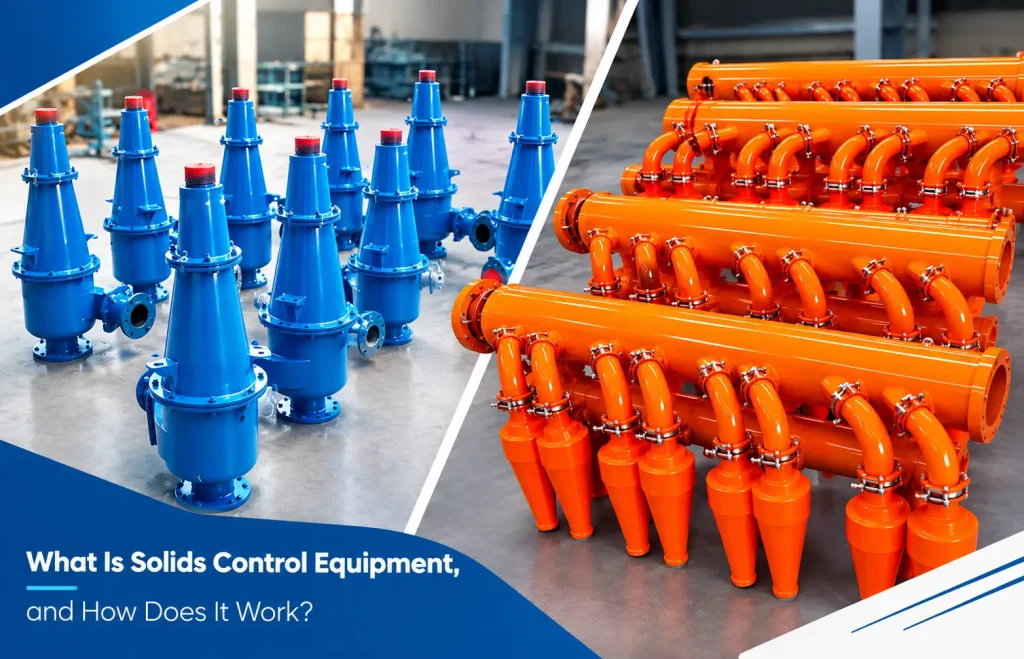
Solids control equipment is the set of surface machines that remove drilled solids and entrained gas from drilling fluid so it can be reused. A typical system works in stages: shale shakers remove the coarsest cuttings, degassers release trapped gas, desanders and desilters (hydrocyclones) remove sand and silt, and decanter centrifuges remove the finest solids and recover barite. Each stage targets a smaller particle size than the one before it.
Without this chain of equipment, drilled solids build up in the circulating system. Mud weight and viscosity climb, pump and bit wear increase, and the fluid has to be diluted or dumped. This guide explains what each machine does, the particle sizes it handles, the order it should run in, and how to keep the whole system efficient.
What Is Solids Control in Drilling?
Solids control is the process of removing unwanted drilled solids from circulating fluid while keeping the useful ones, such as barite and engineered additives. Every foot drilled adds cuttings to the system. If they are not removed, they grind into ever-smaller particles that are harder to separate.
The goal is not zero solids. The goal is to keep low-gravity solids (LGS) within the limits the fluid program allows, so rheology, filter cake quality and mud weight stay predictable.
Solids are usually grouped by size:
| Class | Particle Size | Typical Equipment |
|---|---|---|
| Coarse (sand) | Above 74 microns | Shale shaker, desander |
| Medium (silt) | 2–74 microns | Desilter, mud cleaner, fine screens |
| Fine (clay-size) | Below 2 microns | Decanter centrifuge, chemical treatment, dilution |
Why Solids Control Matters
Effective solids removal affects cost and safety, not just cleanliness:
- Stable mud properties: Less solids buildup means lower plastic viscosity and more consistent rheology.
- Lower dilution cost: Removing solids mechanically is cheaper than diluting with fresh fluid and treating it again.
- Longer equipment life: Fewer abrasive solids reduce wear on pumps, liners, bits and motors.
- Better hole conditions: Cleaner fluid helps limit differential sticking, thick filter cakes and excessive equivalent circulating density.
- Less waste: Cleaner fluid means smaller volumes to haul, treat and dispose of.
The Solids Control Process: Stage by Stage
Equipment is arranged so that fluid passes through progressively finer separation. Skipping or bypassing a stage pushes the load onto the next one, which then performs poorly.
- Primary separation: Scalper and shale shaker screens remove large cuttings.
- Gas removal: Degassers restore fluid density after gas cutting.
- Settling and conditioning: Sand traps and tanks allow heavier particles to drop out.
- Hydrocyclone separation: Desanders, then desilters, remove sand and silt.
- Fine solids removal: Decanter centrifuges handle what the other units cannot.
Each unit should take its feed from the compartment of the active system just before it and discharge into the compartment after it, so fluid always moves forward through the chain.
Shale Shakers: The First Line of Defense
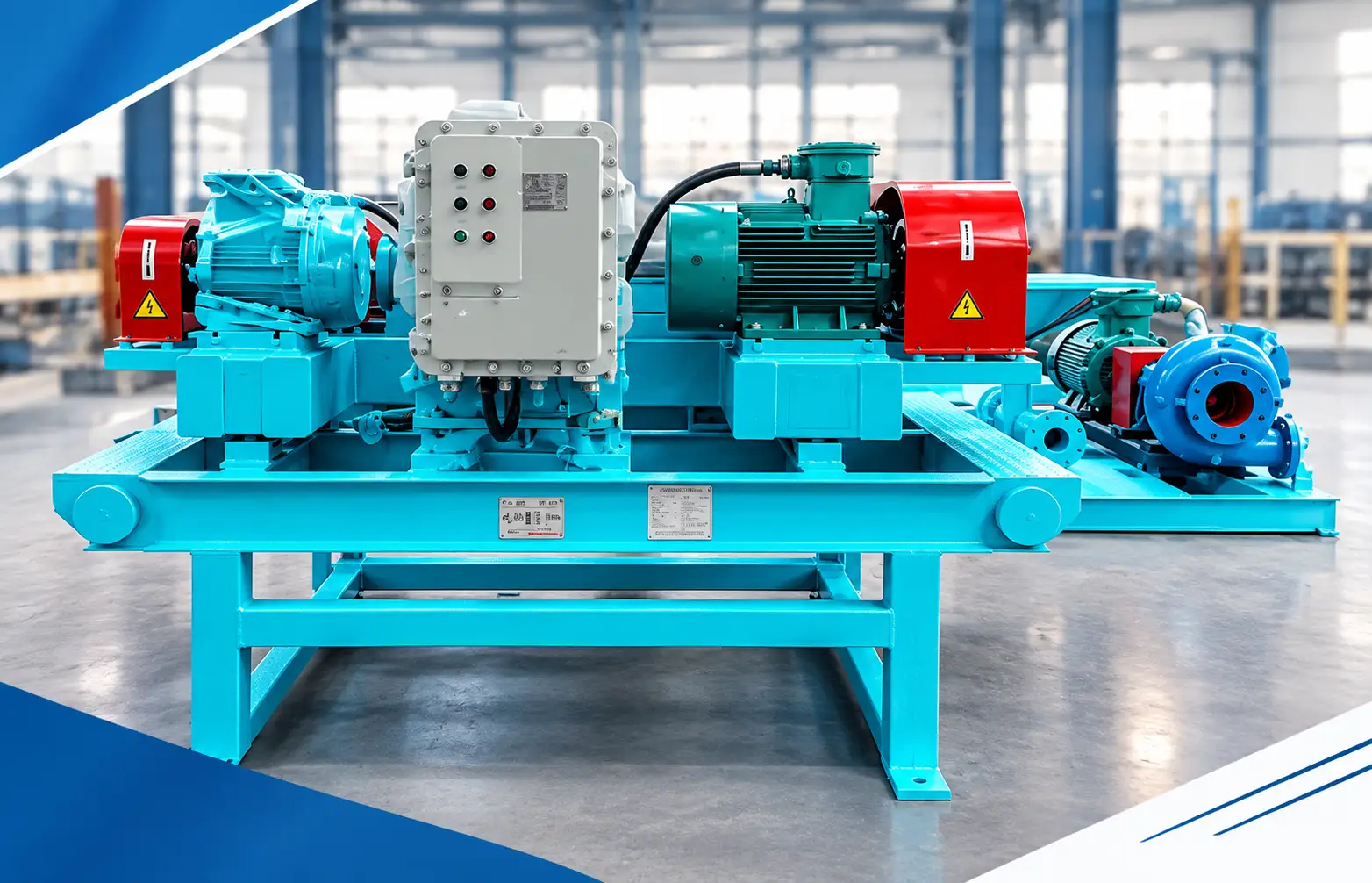
A shale shaker is a vibrating screen that separates cuttings from the returning fluid. It removes the largest share of drilled solids, so its performance sets the workload for every downstream unit.
Shaker Motion Types
| Motion | How It Works | Best For |
|---|---|---|
| Linear | Straight-line vibration with high G-force | Fine screens, sticky or wet cuttings, high flow rates |
| Balanced elliptical | Elliptical path with controlled conveyance | Good general-purpose performance |
| Unbalanced elliptical | Elliptical path with faster solids travel | Coarse formations, high cuttings volume |
| Circular | Circular motion, simpler design | Top-hole sections with large cuttings |
Screens and Mesh Selection
Screen selection is where many rigs lose efficiency. A finer mesh removes more solids but passes less fluid, so the right choice balances flow rate and cut point.
- Use the finest screen that still keeps the fluid on the shaker deck rather than flooding over the end.
- Screens are rated under API RP 13C, which allows different products to be compared by their cut point (D50, D100) rather than mesh number alone.
- Run scalper or coarser screens first when cuttings volume is high, then step finer as the section stabilizes.
- Replace torn or blinded screens immediately. A single hole lets solids bypass the entire system.
Treating shaker screens as a consumable that needs checking each shift is one of the cheapest ways to improve solids control.
Degassers: Restoring Fluid Density
Gas entering the wellbore lowers the apparent mud weight and creates well-control risk. A vacuum or atmospheric degasser breaks out entrained gas so the pumps are fed with fluid of the true density. It should be placed after the shakers and before the hydrocyclones, so cuttings do not clog it and gas-cut fluid does not enter the cyclone feed pump.
Desanders and Desilters: Hydrocyclone Separation
Desanders and desilters are hydrocyclones. A centrifugal pump feeds fluid tangentially into a conical vessel. The spinning motion throws heavier solids outward and down to the underflow, while cleaned fluid leaves from the top.
| Unit | Cone Size | Approx. Cut Point | Role |
|---|---|---|---|
| Desander | 6 in. and larger (commonly 10–12 in.) | 40–74 microns | Removes sand ahead of the desilter |
| Desilter | 4–5 in. | 15–40 microns | Removes silt after the desander |
| Mud cleaner | Desilter cones over a fine screen | Screen-dependent | Recovers weighting material while discarding fine solids |
Key points when running hydrocyclones:
- Feed them the correct pressure and flow rate. Underfed cones discharge poorly and overfed cones lose efficiency.
- Make sure the underflow discharge looks like a fine spray, not a rope. A rope-shaped stream indicates the cone is overloaded.
- Do not run desanders and desilters on weighted mud unless the underflow is screened. Otherwise barite is discarded along with the solids.
Because weighted fluids are expensive, a mud cleaner is usually preferred for them. It discards solids but returns barite to the system.
Decanter Centrifuges: Fine Solids and Barite Recovery
A decanter centrifuge uses a rotating bowl and internal screw conveyor to separate solids at high G-force. It handles particles in the 2–5 micron range, which no screen or hydrocyclone can capture efficiently.
Centrifuges are used in two main modes:
- Weighted mud: The underflow, rich in barite, is returned to the system. The overflow, containing fine low-gravity solids, is discarded or treated.
- Unweighted mud: The centrifuge removes fine solids directly to control viscosity and reduce dilution.
Bowl speed, pool depth and feed rate should be adjusted to the fluid weight and the solids being removed. Running the machine at the wrong settings is a common reason for poor results.
Choosing and Sequencing Equipment
| Condition | Recommended Approach |
|---|---|
| Top hole, large cuttings | Scalper plus coarse shaker screens, desander |
| Intermediate section, unweighted fluid | Full shaker screens, desander, desilter, centrifuge |
| Weighted fluid | Shakers, mud cleaner, centrifuge in barite recovery mode |
| High gas content | Degasser placed immediately after the shakers |
| Oil-based or synthetic fluid | Shakers, centrifuges and cuttings dryers to recover fluid |
The total system should be able to handle the maximum circulation rate, not the average. An undersized system is the most common design problem on older rigs.
Solids Control and Mud Additives
Additives have to be selected with the solids control system in mind, because anything inserted into the fluid has to survive the equipment chain or be deliberately removed by it.
Fine bridging and filtration-control materials are a good example. Micronized grades such as gilsonite powder are often small enough to pass through fine shaker screens, but oversized or poorly graded material can be screened out. Screen choice and additive grade should therefore be considered together rather than separately.
For the fluid side of the system, how solids interact with density and rheology is covered in our overview of drilling mud. Together with fluid design, mechanical solids removal determines how long a mud system can be reused.
Lost circulation material is another case. Fine particles used for loss control can be removed by the solids control system, so replenishment rates need to account for what is discarded; see our guide to gilsonite as a lost circulation material for how this applies to bridging products.
Common Problems and How to Fix Them
| Problem | Likely Cause | Fix |
|---|---|---|
| Fluid flooding off the shaker end | Screen too fine or blinded | Use a coarser screen, clean or replace screens |
| Rising low-gravity solids | Bypassed equipment or low efficiency | Check screens, cone discharge and centrifuge settings |
| Hydrocyclone rope discharge | Overloaded cone or low feed pressure | Reduce feed solids, correct pump pressure |
| Barite lost with solids | Hydrocyclones running on weighted mud | Switch to mud cleaner or centrifuge recovery mode |
| Gas-cut mud returns | Degasser undersized or bypassed | Correct flow path, increase degasser capacity |
| High dilution volumes | Poor mechanical removal | Audit every stage and set solids targets per section |
How to Judge Solids Control Efficiency
Measure rather than guess. Useful checks include:
- Retort and sand content tests on the active system
- Mud weight and LGS percentage trends
- Screen life and cuttings wetness at the shaker discharge
- Dilution volume per section
- Underflow density from hydrocyclones and centrifuges
If dilution volume keeps rising even though every machine appears to be running, a stage is being bypassed or run outside its operating range.
Maintenance Best Practices
- Inspect screens and shaker panels each shift
- Check shaker deck angle and vibration balance regularly
- Keep hydrocyclone feed pressure within the manufacturer’s range
- Replace worn apex and vortex finder parts before they distort the cut
- Service centrifuge bearings, scroll and gearbox on schedule
- Keep tanks agitated and free of settled solids
Frequently Asked Questions
What is solids control equipment in drilling?
Solids control equipment is the group of surface machines that remove drilled solids and gas from drilling fluid. It normally includes shale shakers, degassers, desanders, desilters, mud cleaners and decanter centrifuges.
What is the correct order of solids control equipment?
Fluid normally flows from shale shakers to degassers, then desanders, desilters or mud cleaners, and finally centrifuges. Each stage removes smaller particles than the previous one.
What is the difference between a desander and a desilter?
A desander uses larger cones to remove sand-sized particles, roughly 40–74 microns. A desilter uses smaller cones to remove finer silt, roughly 15–40 microns, and normally runs after the desander.
Why are centrifuges used with weighted mud?
They separate barite from fine low-gravity solids. The barite returns to the system and the fines are discarded, saving weighting material and reducing dilution.
How do I choose the right shaker screen?
Choose the finest screen that still keeps fluid on the deck at the current flow rate. Compare screens by their API RP 13C cut point rather than mesh number alone.
How often should shaker screens be changed?
Screen life depends on formation, flow rate and cuttings type. Inspect them at least every shift and replace any torn or blinded panel immediately.