


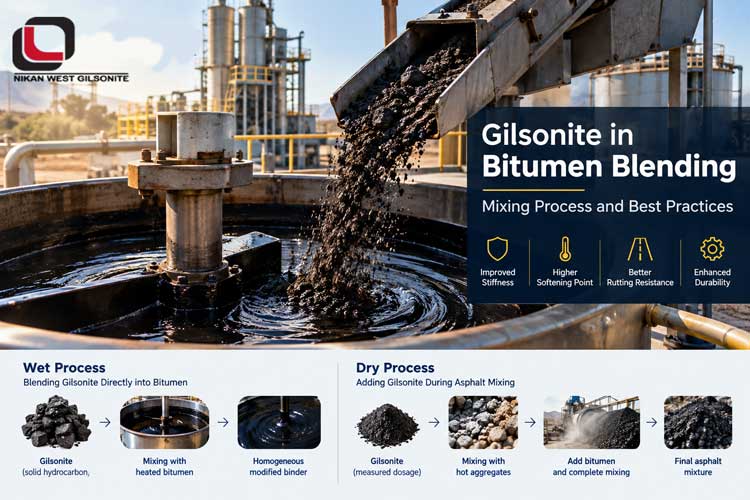
The appropriate gilsonite dosage depends on the original bitumen grade, the desired final properties, the selected gilsonite product, and the intended application.
Some industrial asphalt-modification references discuss replacement levels of approximately 5–15% of the binder, but this range should not be interpreted as a universal prescription. The correct dosage must be established for the specific formulation and verified through testing.
For example, a manufacturer seeking to increase high-temperature stiffness may require a different formulation from one producing a binder that must retain specific low-temperature or workability characteristics.
A controlled dosage trial can help establish the relationship between gilsonite content and the resulting binder properties.
A practical testing program should include:
- Testing the unmodified base bitumen.
- Preparing several trial blends with different gilsonite contents.
- Measuring the relevant physical and rheological properties of each blend.
- Evaluating workability and performance against the project’s requirements.
- Selecting the formulation that meets the applicable specification.
Important: Increasing the gilsonite content does not automatically improve overall asphalt performance. Excessive modification may produce a binder that is too stiff, difficult to handle, or more susceptible to cracking under certain conditions.
Best Practices for Temperature, Mixing Time, and Equipment
Consistent production depends on controlling several interacting variables rather than focusing on temperature or mixing time alone.
Temperature Control
Maintain the temperature recommended for the specific gilsonite grade and blending system. Higher temperatures can accelerate incorporation, but excessive heating can damage the binder and increase fumes.
Use calibrated temperature sensors and avoid unnecessary temperature fluctuations during processing.
Effective Agitation and Recirculation
Mechanical agitation helps distribute gilsonite throughout the binder. Recirculation can further improve uniformity by moving material through different parts of the tank.
The mixing system should be appropriate for the tank geometry, batch size, and viscosity of the modified binder. Dead zones and insufficient circulation can result in uneven blending.
Accurate Dosing
Use calibrated scales, screw feeders, or other suitable dosing equipment to maintain the intended gilsonite-to-bitumen ratio.
For continuous production, synchronize gilsonite feeding with binder flow and overall plant output. This helps prevent variations in the composition of successive batches.
Particle Size and Feed Rate
Gilsonite particle size affects how quickly the material can be incorporated. A suitable grade, combined with controlled feeding and effective agitation, can reduce the likelihood of agglomeration.
Keep the material dry and handle it according to the supplier’s storage recommendations.
Common Gilsonite Blending Problems and How to Prevent Them
Even when the correct materials are selected, inconsistent processing can affect the finished binder.
| Common problem | Possible cause | Recommended action |
|---|---|---|
| Undissolved particles | Insufficient mixing, unsuitable temperature, or coarse particles | Review particle size, agitation, and the validated mixing procedure |
| Agglomeration | Gilsonite added too quickly or inadequate dispersion | Reduce the feed rate and improve agitation |
| Inconsistent binder properties | Incorrect dosage or inadequate circulation | Calibrate dosing equipment and improve sampling |
| Excessive viscosity | High dosage or an unsuitable combination of materials | Reassess the formulation and verify process temperatures |
| Binder aging | Excessive temperature or prolonged heating | Minimize thermal exposure and follow the supplier’s guidance |
| Inconsistent asphalt performance | Variations in aggregate, binder content, or mixing conditions | Review the complete mixture design and production controls |
Troubleshooting should be based on measured results rather than visual appearance alone. A uniform-looking binder can still fail to meet the required specification, so laboratory testing remains essential.
Quality Control and Performance Testing
Quality control should begin before blending and continue through finished-product verification.
First, confirm the incoming materials meet their specified requirements. Next, document the blending temperature, gilsonite dosage, mixing duration, and any relevant equipment settings.
After blending, obtain representative samples using an appropriate sampling procedure.
Depending on the application, quality-control tests may include:
- Penetration testing: Evaluates the consistency of the bitumen.
- Softening point testing: Helps characterize its response to increasing temperature.
- Viscosity testing: Assesses flow behavior under specified conditions.
- Rheological testing: Evaluates performance-related properties under relevant loading and temperature conditions.
- Aging tests: Assess changes in binder properties following standardized aging procedures.
- Asphalt mixture testing: Evaluates properties such as rutting resistance, cracking performance, moisture susceptibility, and mixture stability.
The precise test program should follow the applicable project specification and relevant standards, such as those published by ASTM or AASHTO where required.
For producers using natural bitumen as a feedstock or modifier, material characterization is particularly important. The terms gilsonite, natural bitumen, and petroleum bitumen are related but do not necessarily describe interchangeable materials. Their composition and performance can differ significantly.
Safety Considerations During Gilsonite Blending
Gilsonite blending involves hot bitumen, industrial equipment, and potentially combustible dust or fumes. Appropriate safety controls are therefore essential.
Operators should follow the facility’s risk assessment, equipment instructions, and supplier safety data sheets.
Key precautions include:
- Using suitable heat-resistant personal protective equipment.
- Providing effective ventilation and controlling exposure to fumes.
- Preventing dust accumulation and ignition sources during powder handling.
- Following applicable combustible-dust and explosion-protection requirements.
- Maintaining safe operating limits for tanks, pumps, heaters, and mixers.
- Avoiding water contamination of hot bitumen.
- Establishing procedures for spills, equipment failures, and emergency shutdowns.
Never exceed the approved operating temperature or use a generic temperature recommendation as a substitute for the product’s safety documentation.
Conclusion
Gilsonite in bitumen blending offers manufacturers a practical option for modifying binder stiffness, viscosity, and softening characteristics. When the formulation is appropriate, it can help improve the resistance of asphalt mixtures to permanent deformation under demanding service conditions.
Successful blending requires careful material selection, controlled dosage, suitable temperatures, effective agitation, and systematic quality testing. Both wet and dry processes can be appropriate, depending on the production facility and the intended application.
For manufacturers and contractors, the most reliable approach is to establish the blending procedure through laboratory trials, verify performance against the relevant specifications, and maintain consistent production controls.
Nikan West Gilsonite supports informed material selection by emphasizing the importance of product specifications, application requirements, and process consistency. Before adopting a new formulation, consult the supplier’s technical documentation and validate the proposed mixture under the conditions in which it will be used.
Frequently Asked Questions (FAQs)
1. What is the purpose of gilsonite in bitumen blending?
Gilsonite is used to modify bitumen properties, typically increasing stiffness, viscosity, and softening point. Depending on the formulation, it may help improve asphalt mixture resistance to permanent deformation.
2. What temperature is suitable for blending gilsonite with bitumen?
Some established industrial procedures use temperatures around 170–175°C, while other formulations may require different conditions. The correct temperature depends on the gilsonite grade, base bitumen, equipment, and supplier recommendations.
3. What is the recommended gilsonite dosage?
The appropriate dosage depends on the target binder properties and application. Although some references describe approximately 5–15% binder replacement, the optimum amount must be determined through laboratory trials and verified against the applicable specification.
4. How long does gilsonite take to blend with bitumen?
Mixing time varies with particle size, temperature, batch volume, and agitation. Some industrial processes require several hours, whereas other systems may achieve adequate dispersion more quickly. Confirm completion through appropriate sampling and testing.
5. Is gilsonite better added directly to bitumen or to hot aggregates?
Direct binder blending is useful when a modified binder must be produced and tested separately. Direct addition to aggregates may suit asphalt plants designed for the dry process. The choice depends on plant capabilities, mixture design, and quality-control requirements.