


Shale inhibition is the use of drilling fluid chemistry and physical sealing to stop reactive shale from absorbing water, swelling, and weakening around the wellbore. When shale inhibition fails, the hole becomes unstable: it sloughs, tightens, and packs off, and the drilling team loses time and sometimes the section. Effective control combines the right inhibitor system, correct mud weight, and pore-throat sealing.
Shale makes up roughly three-quarters of the formations drilled in oil and gas wells, and it causes most hole-stability trouble. This guide explains why shale becomes unstable, how each inhibition method works, and how to choose a strategy for your well.
What Is Wellbore Instability?
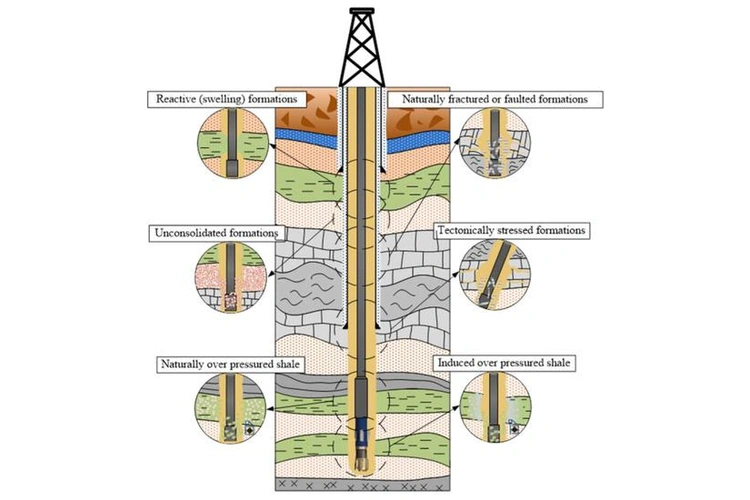
Wellbore instability is any condition where the hole fails to stay in gauge and in one piece during drilling. It shows up in two forms:
- Hole narrowing (tight hole): swelling or plastic shale squeezes into the wellbore, causing torque, drag, and stuck pipe.
- Hole enlargement (washout and caving): brittle or fractured shale breaks off in pieces, leaving oversized sections that are hard to clean and cement.
The causes are never purely chemical. Instability results from three interacting factors:
| Factor | What happens | Typical effect |
|---|---|---|
| Mechanical | Mud weight is too low or too high for the in-situ stress | Collapse (too low) or induced fractures (too high) |
| Chemical | Water from the mud reacts with clay minerals | Swelling, softening, dispersion |
| Hydraulic / thermal | Filtrate raises near-wellbore pore pressure; temperature changes alter stress | Delayed failure hours or days after drilling |
Treating only one of these is the most common reason a “well-inhibited” mud still loses the hole.
Why Shale Reacts With Water-Based Mud
Shale is a fine-grained rock with very low permeability, dominated by clay minerals. Its behavior depends on which clays it contains:
- Smectite (montmorillonite): highly reactive; absorbs large amounts of water between its layers and swells.
- Illite: less swelling, but prone to dispersion and brittle failure.
- Kaolinite and chlorite: low swelling, but can disintegrate when the rock is fractured.
- Mixed-layer clays: variable behavior; common in mid-depth formations.
Three mechanisms drive the damage:
- Surface hydration: water molecules attach to clay surfaces and layers, causing swelling pressure.
- Osmotic hydration: if the water activity of the mud is higher than that of the shale, water moves into the rock.
- Pore pressure transmission: even tiny volumes of filtrate entering micro-fractures raise pore pressure near the wellbore, which reduces the effective support holding the rock in place.
Because shale pores are extremely small, pressure can penetrate and weaken the rock faster than you might expect from its low permeability alone.
Warning Signs of Shale Instability
Rig crews and mud engineers usually see these indicators before a serious incident:
- Increased torque, drag, and overpull on connections or trips
- Excess cuttings at the shaker, especially large, splintery, or angular pieces
- Soft, sticky, or mushy cuttings, which suggest hydration
- Rising mud solids, viscosity, or fines content
- Fill on bottom after a trip
- Pack-off and stuck pipe
- Caliper or sonic logs showing washouts or tight sections
Cuttings shape matters: splintery or angular cavings usually point to mechanical failure from low mud weight, while soft, rounded, or gummy cuttings point to chemical hydration.
How Shale Inhibition Works: The Main Methods
No single additive solves every shale. Modern programs combine several mechanisms.
1. Ionic inhibition
Potassium ions (usually from KCl) fit into the clay interlayer space and hold the layers together, which limits swelling. Other salts, such as sodium chloride, calcium chloride, and formate brines, also lower water activity to reduce osmotic flow. Ionic inhibition is cost-effective and well understood, but it works best alongside an encapsulating polymer.
2. Polymer encapsulation
Long-chain polymers coat cuttings and exposed wellbore surfaces, slowing hydration and keeping cuttings intact so they can be removed at the surface. Partially hydrolyzed polyacrylamide is the best-known example, and it is typically paired with potassium. This is the backbone of many water-based inhibitive systems.
3. Glycols and amines
Polyglycols can come out of solution at the bottomhole temperature (the “cloud point”) and form a film that blocks water movement. Amine-based inhibitors adsorb strongly onto clay surfaces. Both are used when salt-polymer systems alone are not strong enough, and both need compatibility testing with the rest of the mud.
4. Silicate systems
Silicates react with formation fluids and calcium to form a gel-like deposit in pores and fractures. They offer strong inhibition and sealing but require careful pH control and handling.
5. Oil-based and synthetic-based muds
In an invert emulsion, shale sees oil as the continuous phase, so water cannot easily contact the clay. The internal brine phase is salinity-balanced to the shale’s water activity, creating an effective membrane that prevents osmotic hydration. These systems deliver the best inhibition but come with higher cost, waste handling, and environmental constraints.
6. Physical sealing of pores and micro-fractures
Chemical inhibition slows reactions, but the filtrate still has to be stopped from entering. Sealing additives bridge and plug the smallest pore throats and micro-fractures so the mud cake becomes tighter and pressure transmission is reduced. Common sealing materials include:
- Sized calcium carbonate and graphite
- Sulfonated asphalt and blown asphalt
- Micronized organic resins
- Natural, high-softening-point hydrocarbons, such as gilsonite
Gilsonite is a particularly good fit for this job because its particles deform under downhole temperature and differential pressure, which lets them fill micro-fractures that rigid particles cannot seal. The quality of that sealing depends on softening point, ash content, and particle size, which are set at the source. A reliable producer that controls everything from the Gilsonite mine through grinding and packaging can supply consistent grades for drilling programs, so the performance you test in the lab is the performance you get on the rig.
Comparing Shale Inhibition Systems
| System | Inhibition strength | Main benefit | Main limitation |
|---|---|---|---|
| KCl-polymer water-based | Moderate to good | Low cost, simple to maintain | Less effective in highly reactive or fractured shale |
| Glycol or amine enhanced WBM | Good | Strong clay-surface protection | Needs temperature and compatibility checks |
| Silicate WBM | Good to very good | Strong sealing action | Narrow pH window |
| Oil or synthetic-based mud | Very good | Near-zero shale hydration | Cost and environmental limits |
| Any system + sealing additive | Adds to the base system | Reduces filtrate and pressure transmission | Particle size must match pore throat |
How to Choose a Shale Inhibition Strategy
Use these steps as a decision framework:
- Identify the shale. Use offset well data, cuttings analysis, cation exchange capacity, X-ray diffraction, and capillary suction or swelling tests to find out what clays you are drilling.
- Define the mud weight window. Establish pore pressure, collapse pressure, and fracture gradient before choosing chemistry. Chemistry cannot fix a mud weight that is too low.
- Match the system to the risk. Reactive, young shales usually need stronger inhibition than older, compacted shales.
- Add sealing for fractured or microfractured shale. Include a sealing package sized to the pore throats and fractures you expect.
- Test before spudding. Run hot-roll dispersion, shale recovery, and bulk hardness tests with the actual mud and field cuttings.
- Monitor and adjust. Track inhibitor concentration, chlorides, filtrate, cuttings quality, and torque and drag trends, and adjust early.
Common Mistakes That Cause Shale Problems
- Relying on chemistry alone when the mud weight is below the collapse pressure
- Using one inhibitor and ignoring pore-throat sealing
- Letting inhibitor concentrations drop through dilution without noticing
- Skipping lab tests on real cuttings
- Leaving a shale section exposed too long, since time-dependent effects grow with exposure
- Overlooking temperature, which can change polymer, glycol, and amine performance
Conclusion
Controlling shale and wellbore instability comes down to three things: knowing your shale, setting the right mud weight, and combining inhibition with pore sealing. When these work together, you drill a cleaner, in-gauge hole with fewer trips, less stuck-pipe risk, and lower overall cost.
Frequently Asked Questions
What is shale inhibition in drilling?
Shale inhibition is the practice of preventing reactive shale from absorbing water and swelling or breaking apart while drilling. It uses salts, polymers, glycols, amines, silicates, oil-based fluids, and sealing additives to protect the wellbore.
What causes wellbore instability in shale?
It is caused by a combination of mechanical stress imbalance (wrong mud weight), chemical reactions between mud and clay, and pressure or temperature changes that build up over time.
What is the best shale inhibitor?
There is no single best option. Oil-based and synthetic-based muds provide the strongest inhibition, while KCl-polymer, glycol, amine, and silicate water-based systems are chosen according to the shale type, cost, and environmental rules.
How does KCl stop shale swelling?
Potassium ions fit between clay layers and bind them together, which reduces the space available for water to enter.
Can mud weight alone stabilize shale?
No. Mud weight controls mechanical stability but not chemical reaction. Most shale problems need both the correct mud weight and an effective inhibition system.
How do sealing additives help with shale?
They plug micro-fractures and tiny pores, which reduces filtrate invasion and slows pressure transmission into the shale, helping to keep the formation stable over time.
How can I tell chemical instability from mechanical instability?
Soft, gummy cuttings and rising solids suggest chemical hydration. Sharp, splintery cavings suggest mechanical failure from low mud weight or stress.