


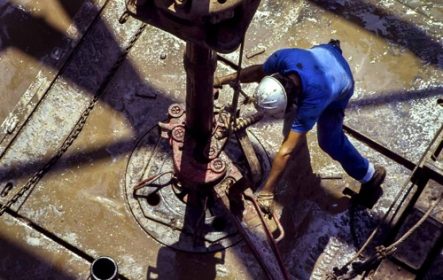
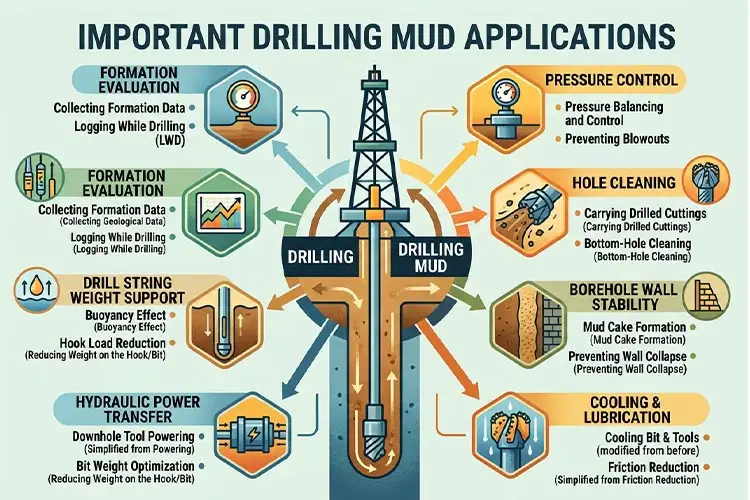
The most important applications of drilling mud are removing rock cuttings from the well, cooling and lubricating the drill bit, and stabilizing the wellbore wall against collapse. Together, these functions make deep-well drilling in oil, gas, and water exploration possible, faster, and safer.
Drilling mud, or drilling fluid, is one of the most essential materials in deep-well drilling. In oil, gas, water, and mineral exploration, reaching the subsoil through deep wells is simply not possible without it. This guide from Nikan West Gilsonite Company, a gilsonite producer based in Gilan-e-Gharb, Kermanshah, Iran, focuses specifically on the core applications of drilling mud — what it does at the wellbore and why each function matters.
1. Removing Drill Cuttings
The first and most important application of drilling mud is removing rock chips and debris generated by the drill bit from the bottom of the well. As the fluid circulates, cuttings are suspended and carried up to the surface, allowing drilling to continue without the well clogging.
This is not limited to removal alone — as the chips exit, the same fluid flow cools the drill bit, helping it run more smoothly and extending its working life.
2. Cooling and Lubricating the Drill
Mechanical and hydraulic pressure during drilling generates significant heat, which must be managed or it will damage the drill bit and other equipment. Drilling mud circulating past the bit continuously carries this heat away and reduces friction, letting the drill rotate more smoothly and efficiently.
3. Stabilizing the Well Wall
Deep wells are highly prone to collapse under drilling pressure and physical imbalance. Drilling mud prevents this in two distinct ways:
- Hydrostatic pressure — the mud presses against the wellbore wall, counteracting the forces that would otherwise cause it to cave in.
- Pore-filling — the mud penetrates pores and micro-fractures in the wall, filling them to reduce permeability and reinforce the formation.
This second mechanism is also why fluid can be lost into the formation through the well wall — a trade-off that fluid loss control additive are specifically designed to manage.
Why These Applications Matter Together
None of these three applications work in isolation. A drilling mud that removes cuttings well but fails to stabilize the wall risks a collapsed well. One that stabilizes the wall but doesn’t cool the bit shortens equipment life. This is why drilling fluid engineers continuously balance mud properties — weight, viscosity, and additive composition — for each specific well, rather than using one fixed formula everywhere.
(For a full breakdown of how mud weight is calculated and why it matters for these applications, see our guide on drilling mud weight. For the full range of mud types and additives, see our complete guide to drilling mud.)
Frequently Asked Questions
What is the main application of drilling mud?
Its main application is removing rock cuttings from the well as drilling progresses, though it also cools the drill bit and stabilizes the wellbore wall at the same time.
How does drilling mud prevent well collapse?
It applies hydrostatic pressure against the wellbore wall and fills pores and micro-fractures in the formation, both of which reinforce the wall against collapse.
Does drilling mud only remove cuttings, or does it do more?
It does more — alongside cutting removal, it cools and lubricates the drill bit and helps maintain wellbore stability, all through continuous circulation.
Why is cooling the drill bit important?
Without cooling, heat generated by mechanical and hydraulic pressure during drilling would damage the bit and other equipment, shortening their working life and reducing drilling efficiency.